Université d'Orléans · Sciences Économiques · 2004
Four chapters on how a currency price is made
Information that arrives unevenly, traders who disagree and change their minds, and a trading time that is itself random. Each chapter is being rebuilt as a model you can run — from the equations in the original manuscript, not from its printed figures.
Two laboratories are live. Two chapters are in preparation.
Université d'Orléans
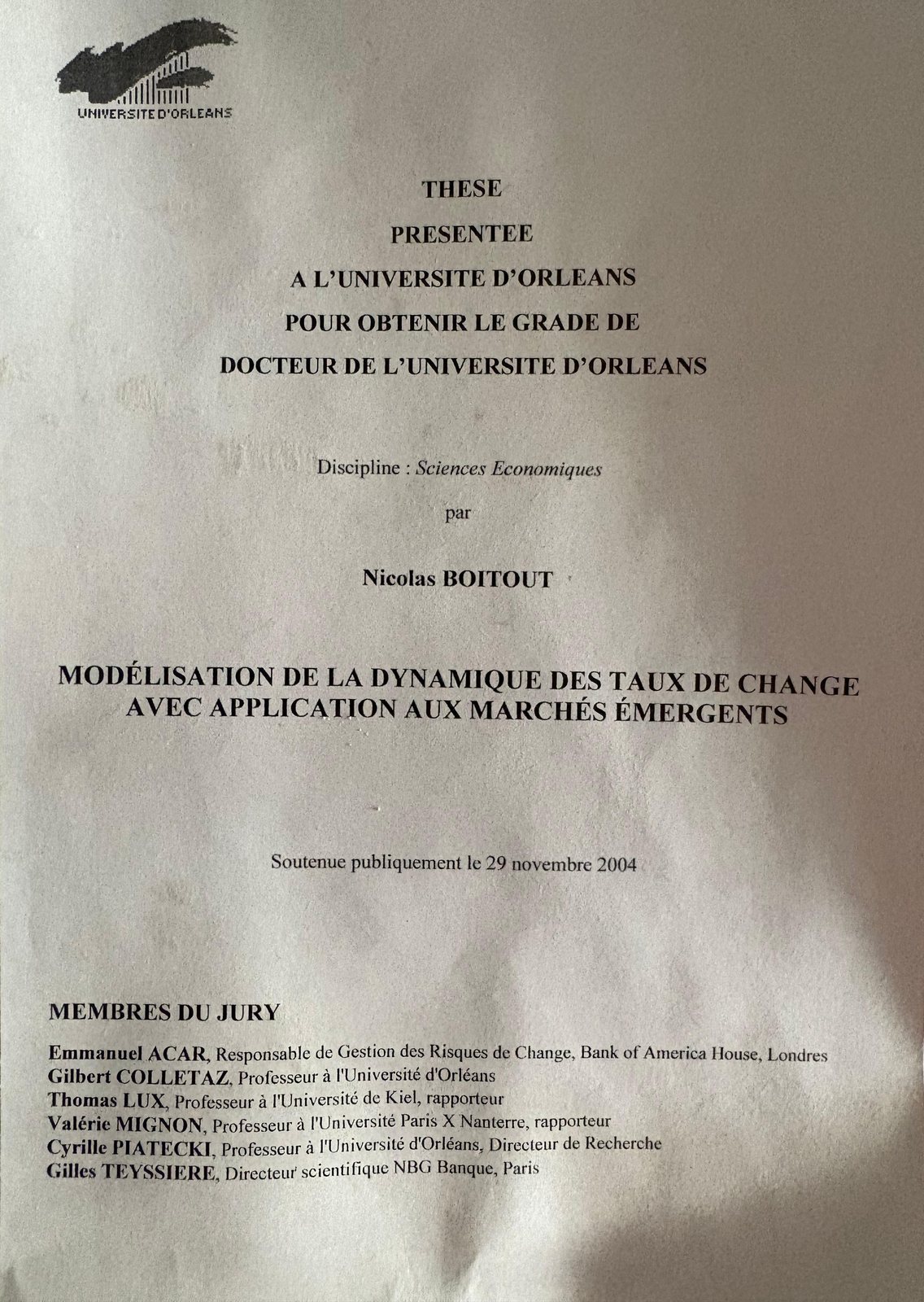
Thèse
présentée
à l'Université d'Orléans
pour obtenir le grade de
Docteur de l'Université d'Orléans
Discipline : Sciences Économiques
par
Nicolas Boitout
Modélisation de la dynamique des taux de change avec application aux marchés émergents
Soutenue publiquement le 29 novembre 2004
-
Chapter One Interactive
Towards a multifractal paradigm of stochastic volatility
Information does not arrive evenly, and almost every familiar feature of returns follows from that one assumption. Fat tails, volatility that clusters, memory that changes with the power you measure and the horizon you use.
With Loredana Ureche-Rangau · International Journal of Theoretical and Applied Finance 7(7), 823–851, 2004 · DOI
-
Chapter Two Interactive
Agent-based financial market simulation
A market made of people who disagree. Two chartist camps and a fundamentalist camp, each agent switching when someone else's strategy is doing better — and, unlike almost every simulation of its day, trading time is random rather than a grid.
With Thierry Delahaut · extends Lux & Marchesi (1999, 2000) to random trading time
-
Chapter Three In preparation
Empirical Study
-
Chapter Four In preparation
Speculative Attacks on a Fixed Exchange Rate Market: a Microsimulation
The intuition
Why I approached currency crises this way
The standard account never added up for me. If prices move because news arrives, and news reaches everyone at once and is read in much the same way, then the volatility we actually observe in currency markets is far too large. You can find the intraday spikes around announcements — but they are a small part of the total. Most of the movement was being produced by something other than public information.
The foreign exchange market makes the alternative hard to avoid. It is decentralised: there is no tape of aggregate order flow, so what a trader learns about everyone else, they learn from price and volume themselves. Other participants are not noise around the fundamental — they are part of what you are trading on. That is also why technical analysis dominates short-horizon forecasting there, whatever one thinks of it.
So I stopped treating the representative investor on a regular clock as the starting point. Take it away and you need to say what replaces it, which is the whole dissertation: information that arrives in bursts, agents who revise their method by watching what is working for other people, and a trading time that runs fast and slow instead of ticking.
Crises are where this stops being a modelling preference. A fixed exchange rate does not break because a fundamental crossed a threshold on a particular Tuesday. It breaks because enough participants revise at once, each partly because the others are revising — a herd that is individually rational and collectively catastrophic. A representative agent cannot even state that problem. A population that switches strategy, in a market where the only signal about everyone else is the price, can.
That is why the emerging-market application at the end is not an afterthought bolted onto the theory. It is the case the theory was built for.
A note on the rebuilds. Each laboratory is written from its chapter's own equations, not from its published figures. Where the manuscript is ambiguous, silent, or missing pages, the implementation says so on the page and names the reading it took. Nothing is quietly corrected and nothing is modernised.
Defence and jury
Publicly defended on 29 November 2004 at the Université d'Orléans.
- Emmanuel AcarHead of Foreign Exchange Risk Management, Bank of America House, London
- Gilbert ColletazProfessor, Université d'Orléans
- Thomas LuxProfessor, University of Kiel · rapporteur
- Valérie MignonProfessor, Université Paris X Nanterre · rapporteur
- Cyrille PiateckiProfessor, Université d'Orléans · research director
- Gilles TeyssièreScientific Director, NBG Banque, Paris